2.3. The Reed-Pen⁑
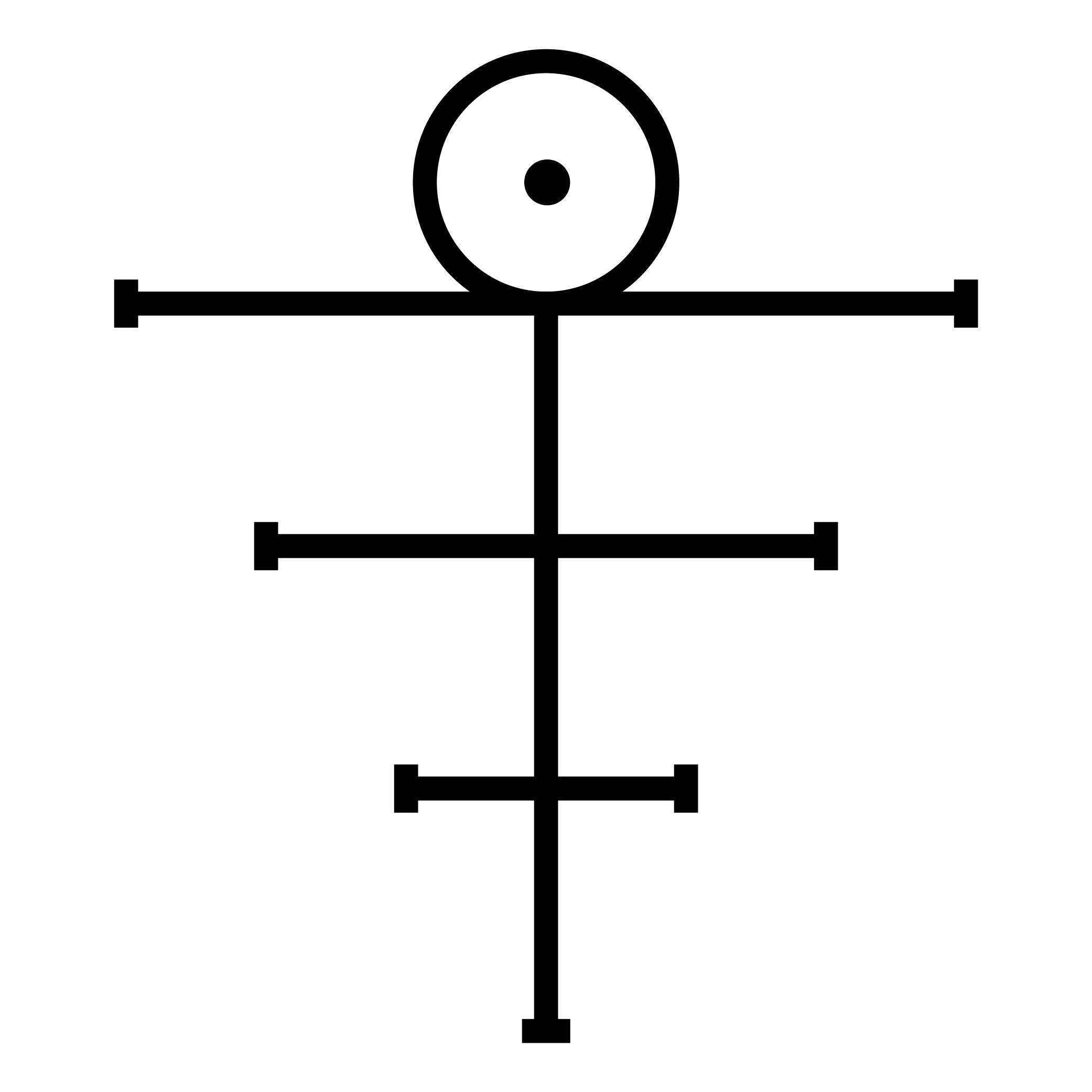
The symbol used to represent the Way of Hermēs generally and the Hermetic Synaxis specifically is called the Kalamos, the “Reed-Pen of Hermēs Trismegistos”.
2.3.1. Construction⁑
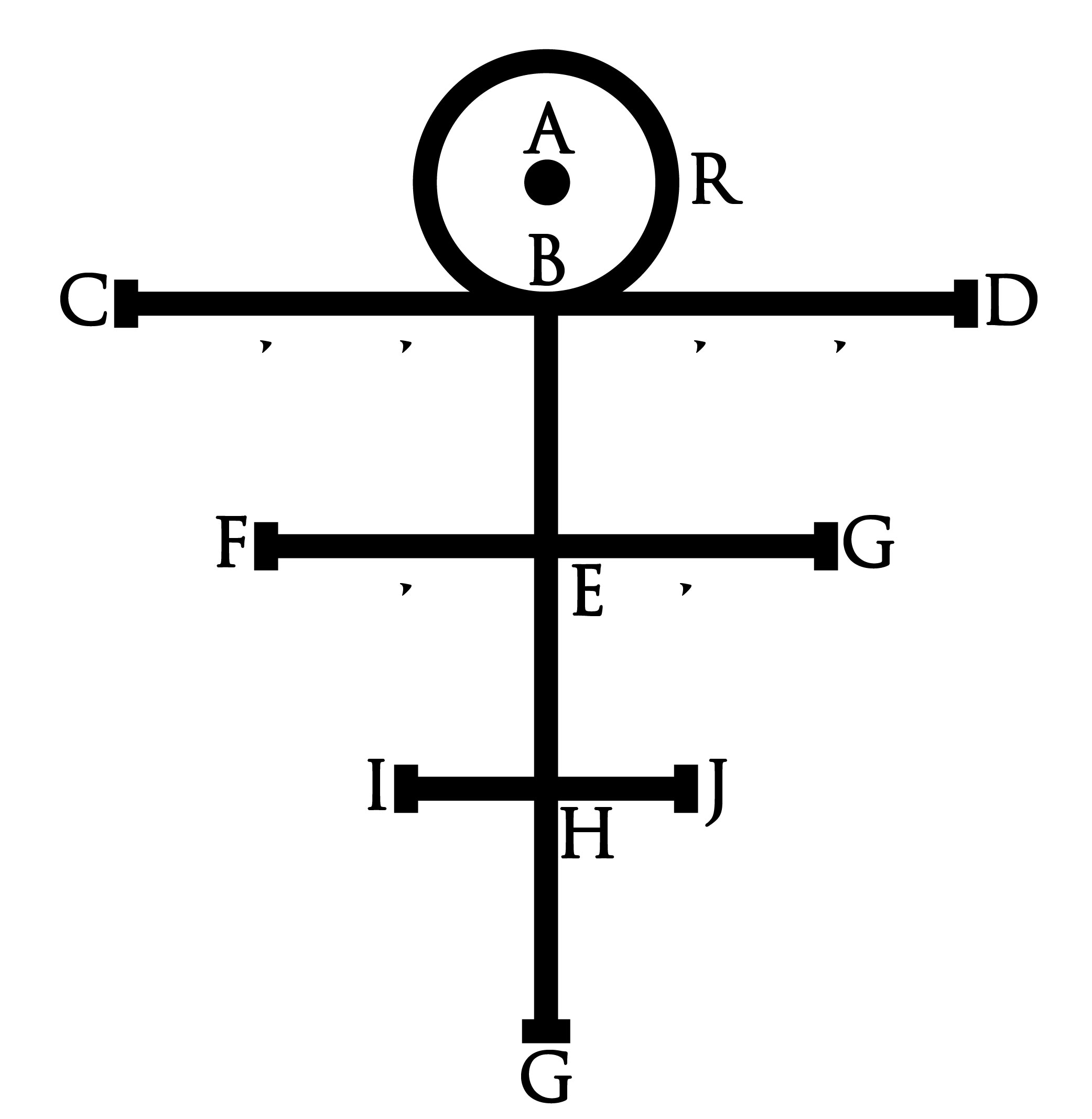
Draw a point A.
Draw a circle AR with the point A as its center, and let the radius R of this circle be a unit.
Tangent to the circle AR at its bottommost point B:
Draw a horizontal line BC three units long to the left.
Draw a horizontal line BD three units long to the right.
Draw a vertical line BE two units long downwards.
From the point E:
Draw a horizontal line EF two units long to the left.
Draw a horizontal line EG two units long to the right.
Draw a vertical line EH two units long downwards.
From the point H:
Draw a horizontal line HI one unit long to the left.
Draw a horizontal line HJ one unit long to the right.
Draw a vertical line HK two units downwards.
The resulting figure should resemble a pointed circle of radius one unit atop a vertical line six units long, crossed by three horizontal lines of six units, four units, and two units in descending order to resemble a skeleton of a downwards-pointing equilateral triangle.
2.3.2. Gripping the Pen⁑
In the same way that the word “gait” refers to a manner of carrying oneself, the pattern of movements of the limbs that allow for particular speeds and styles of walking across different terrain or for different purposes, the word “grip” refers to a similar idea in penmanship, the way one physically holds a pen, the positions and angles of the fingers and wrist, that allow for different styles of handwriting to be produced. Some of these styles are faster or slower, some with more or fewer flourishes, some for artful calligraphy or for utilitarian transcribing. In similar ways, the Kalamos can be grasped any number of ways, each way making use of the Kalamos for different mnemonic and symbolic purposes for the student to bear in mind various aspects of the Way of Hermēs. By holding the Kalamos in different grips, the student can transform this Kalamos into a key, scepter, wand, pen, or any other number of tools as needed for contemplation or consideration.
2.3.2.1. The First Grip: the Gaze⁑
The Kalamos may be used as a meditative device by fixing the gaze at the point A. Regardless of the rest of the drawing and whatever parts it might symbolize, the gaze should be fixed, held upon, and sunk into the point A, as if staring into a single eye. When one does this, the eye will still want to follow the rest of the symbol downwards, given how it is drawn like the skeleton of a downwards-pointing triangle. The tension between trying to hold the gaze at the point A while the eye wants to look downwards is to be sat with and understood on its own terms as itself an emblem of the tension we have as twofold entities.
2.3.2.2. The Second Grip: the Ancient Symbols⁑
The Kalamos may be seen as a diagram reminding the student of the various symbols of ancient spiritualities that influenced the development of the Way of Hermēs:
The circle AR together with its central point A resembles the Egyptian symbol for the Sun, and also the Greek geometric drawing of the Monad.
The circle AR atop the horizontal line CD and the vertical line BK resembles the Egyptian symbol of the ankh.
The vertical line BK crossed by the horizontal lines CD, FG, and IJ resembles the Egyptian symbol of the djed.
The circle AR atop the vertical line BK resembles the Egyptian scepters of power, like the Was-scepter and Sekhem-scepter.
The circle AR together with the horizontal lines CD, FG, and IJ together with the vertical line BK resembles the Greek symbol of the caduceus.
The points C, D, E, F, G, H, I, J, and K together with the two points at the end of the first units to the left and right of point B yield ten points total in a triangular arrangement, resembling the Pythagorean Tetraktys.
2.3.2.3. The Third Grip: the Teacher and Teachings⁑
The Kalamos may be seen as a diagram reminding the student of the various virtues, works, and teachings of Hermēs Trismegistos:
The vertical line BK is for the whole Way of Hermēs: to combine reverence with knowledge.
The vertical lines BE, EH, and HK are for both:
The three seeds of God: virtue, moderation, reverence
The threefold way to the Good: to be able to know, will, and hope
The three parts of understanding: to think, to remember, to be thankful
The horizontal lines CD, FG, and IJ are for both:
Hermēs’ primacy as philosopher, priest, and king
The three Hermetic arts of astrology, theurgy, and alchemy
The seven terminals of the lines C, D, F, G, I, J, and K are for the seven lesser divine mercies that chase away individual tormentors: knowledge, joy, self-control, perseverance, justice, liberality, and truth.
The three terminals on the left C, F, and I stand for the Greek word ΖΟΗ zōē “Life”; the three terminals on the right D, G, and J stand for the Greek word ΦΩΣ phōs “Light”; the points between them B, E, H, and K stand for the Greek word ΘΕΟΣ theos “God”.
The point A, the radius R, and the circle AR are for the three greater divine mercies that give rise to all things and chase away all torment: Goodness, Light, and Life.
The points A, B, E, H, and K are for the progression of divinity manifest in the world: God, mind, soul, spirit, body.
2.3.2.4. The Fourth Grip: the Generations of Wisdom⁑
The Kalamos may be seen as a diagram reminding the student of how wisdom is received and transmitted through different teachers and students:
The point A represents the Godhead, the glory of the all and the source of all wisdom and the all.
The circle AR represents Poimandrēs, the god who came to reveal the mysteries for the first time.
The vertical line BK represents Hermēs, the teacher throughout all generations, the thread of wisdom throughout all teachers.
The three horizontal lines CD, FG, and IJ represent Tat, Asklēpios, and Ammōn as the students of Hermēs who were taught and themselves taught the wisdom of their teacher.
The point K represents you, the student who receives the wisdom of Hermēs and all past generations of teachers.
2.3.2.5. The Fifth Grip: the Cosmos⁑
The Kalamos may be seen as a diagram reminding the student of the various parts of our cosmos:
The seven terminals of the lines C, D, F, G, I, J, and K are for the seven planets: Moon and Sun, Saturn and Jupiter, Venus and Mars, and Mercury.
The twelve units that compose the horizontal lines CD, FG, and IJ are for the twelve signs of the Zodiac.
The three horizontal lines CD, FG, and IJ are for both:
The three kinds of celestial objects: decans, signs of the Zodiac, and planets
The three kinds of stars: fixed, luminary wandering, non-luminary wandering
The point K together with the three horizontal lines IJ, FG, and CD together with the circle AR are for the various levels of the cosmos: the Earth, the inner heavens (Moon through Sun), the outer heavens (Mars through Saturn), the sphere of the fixed stars, and the endless starless sphere.
The four points of the vertical line BEHK are for the four elements: Fire, Air, Water, and Earth.